I was given some really old 8mm and 16mm colour film, it is too old to shoot with as the emulsion on the film isn't useful anymore due to age. However there is other technique I could use the film for. And one i've come across is burying the film into soil, which erodes the emulsion and strips away parts to create a weathered and damaged look to the film and also for unshot footage it can create a series of colours and patterns. I've started looking into useful blogs on this and also below are some videos I've found from Vimeo that use this technique.
http://www.rogerdwilson.ca/experiment--1.html
http://www.rogerdwilson.ca/2/post/2013/04/film-decay-burying-film-in-a-leaf-and-soil-compost.html#comments
Final Piece
24/04/2014
Reading | writing | Ideastap | Interviews and Articles
I have started to actively seek and read articles relating to my practice more often, I struggle with large amounts of reading and find short articles are better for me to pick up more information. Also there is a range of articles, reviews, overviews and interviews out there, while I write my own it is also important for me to read these for that reason also. Self teaching in learning structure, styles of writing and also at the same time gaining valuable information from it.
I read a lot of articles from ideastap and recently quite a few on on writing here are a few I found interesting and helpful....
Jackie Kay on being a writer
http://www.ideastap.com/IdeasMag/the-knowledge/poet-novelist-jackie-kay-interview
Novelist Samantha Shannon on writing dystopian fiction
http://www.ideastap.com/IdeasMag/the-knowledge/samantha-shannon-bone-season
Richard Tyrone Jones on writing and programming spoken word
http://www.ideastap.com/ideasmag/the-knowledge/richard-tyrone-jones-spoken-word-exercises
Jeremy Herrin on new writing
http://www.ideastap.com/ideasmag/the-knowledge/headlong-jeremy-herrin-directing-new-writing
Sean Gandini on how to juggle
http://www.ideastap.com/ideasmag/the-knowledge/sean-gandini-how-to-juggle

20/04/2014
Research | Writing | Film Critics | Indiewire Article
Writing film reviews has always been something I do on the side, I love films and I love writing and the two just came together. It was more for my benefit to strengthen my writing on a subject I love. It's not aimed at an audience and it's definitely not there to force my opinion of the film upon anyone. If people read it and like it, it's an added bonus for me. I've always written how I feel about the film, in a way I know best, trying to avoid being one way or another with how I saw the film, just keeping it honest and interesting. But at the same time reminding people this is just what I thought, we all have different tastes in things and that's okay.
My favourite response to my writing went along the lines of "I enjoyed reading your review, but I don't agree with what you thought about the film." I liked this honesty and it also sparked interesting conversations about how each of us viewed the film. However everything I know about films is self taught, or information i've made an effort to find. I've not studied things like film studies, media or any film related course, this sometimes makes me question "Can I write film reviews if I haven't studied film?" My thoughts are, if you're passionate about something you will learn what there is to know about that subject or make a good attempt at it at least. Also if we all had the same training and background wouldn't that result in similar if not the same work from everyone, in style, angle and approach.
How we live our lives and the interests, training and source of information defines us and I think that follows nicely over to things like film reviews. Writing requires a voice, and developing your own voice as text can be a hard thing, but if you just go about writing things in a technical, standard way, most of the audience is bound to get bored or not read. You need to place something personal to the piece, your opinions count, but there is different ways you can show this.
There is a great discussion in the link to the article below questioning what critics should and shouldn't write about, overall being that there is never a shouldn't. There is many things you can talk about for a film, from plot, story, acting, to how the audience response, your ideas and thought that arose form watching and so on. However all reviews are open for discussion and never fact. I've always been told to take the angle of how I view the film and highlight points others may not have seen or notices. Like bringing something new to the table in an interesting way that will capture an audience, but not stray too far from the purpose of the piece.
http://blogs.indiewire.com/criticwire/critics-should-definitely-write-about-form-except-when-they-dont-want-to
19/04/2014
Research | Dear Progress | Micah Purnell
http://www.dearprogress.co.uk/
Series of billboard written by conceptual artist and graphic designer Micah Purnell, with statements relating to him personally about progression and work, but open statements that can speak to an audience as a whole.
How to get people to stop and read, make it big, make it exist in a place people are used to looking and reading.


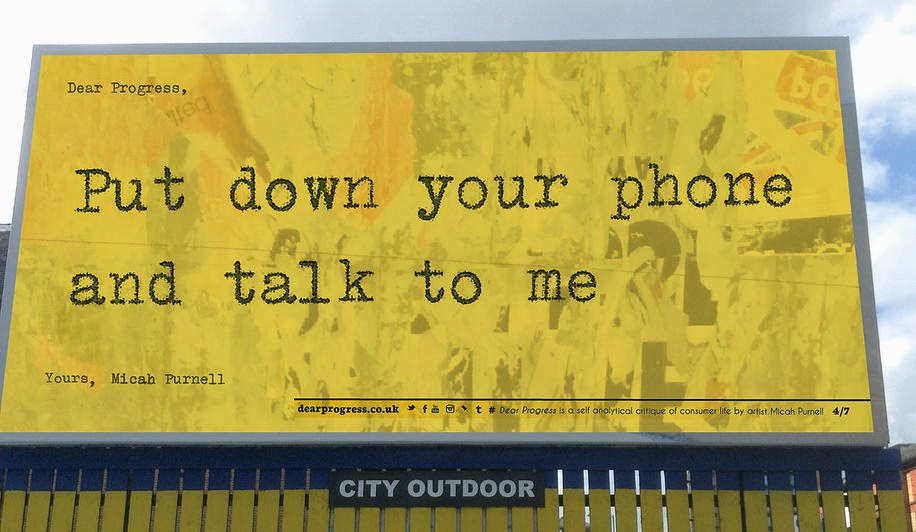
Funded my Arts council
Series of billboard written by conceptual artist and graphic designer Micah Purnell, with statements relating to him personally about progression and work, but open statements that can speak to an audience as a whole.
How to get people to stop and read, make it big, make it exist in a place people are used to looking and reading.
Funded my Arts council
17/04/2014
HOARD | Towards An Archaeology of The Artist Mind | Quotes to translate
Upon looking at the stock in Blott, I came across a series of stationary called 'citations' and the quotes on them all revolve around writing by writers. This got me thinking about the quotes and/or text I translate using the dictionary and these quotes work well. Not only is it old text, it is quotes aimed at what it means to write and have a strong literature connection. By extending and pulling apart to find the meaning of these, I am expanding on my exploration of art and literature.
The collection can be found here... http://www.blottshop.com/brand/Citations/27
Below is the list of quotes used, which will be a good place to start as I collect up various quotes on this subject.
List of the Quotes
"There is something very comfortable in having plenty of stationary." - Charles Dickens, Great Expectations
"The pen is mightier than the sword." - Edward Lytton Wheeler
"If you want to change the world, pick up your pen and write." - Martin Luther
"The pen is mightier than the sword, and considerably easier to write with." - Marty Feldman
"All I need is a sheet of paper and something to write with, and then I can turn the world upside down." - Friedrich Nietzsche
"To me, the greatest pleasure of writing is not what it's about, but the inner music that words make." - Truman Capote
"Fill your paper with the breathings of your heart." - William Wordsworth
"I can always live by my pen" - Jane Austen
"The pen is the tongue of the mind." - Horace
"Either write something worth reading or do something worth writing." - Benjamin Franklin
"Only on paper has humanity yet achieved glory, beauty, truth, knowledge, virtue, and abiding love." - George Barnard Shaw
"I'll call for pen and ink and write my mind." William Shakespeare
HOARD | Towards An Archaeology of The Artist Mind | A book to the collection
Using this opportunity of the space at the Departure Foundation with HOARD I have started a collection of books which I can store and use to expand further on my exploration between text and language bridging the link between art and literature.
Today I picked up a 1894 collection of Shakespeare's work. At what I first thought to be a misprinted version of Shakespeare's name, I found wasn't the case when I investigated this further. It turns out that it is an old version of the spelling of his name, which is also the case with some one the words used in his writing and also the names of his plays.
This is my first addition to what I hope to be a big collection of books and text, documenting each step of what I find and the variations of books. It will be a small collection that will be a example of text, language and its many forms.
16/04/2014
HOARD | Towards An Archaeology of The Artist Mind | Space and Ideas
Having just got the great news of my application being accepted for a place as an artist with the year long HOARD project, it got me thinking about how I can use this space to further my exploration and aid my practice.
I have decided to pull through all the ideas I have and use this space to collect text, creating a place that I can look deeper into language while surrounded by books. It gives me a place to go to pull apart sentences and words getting to the core of understanding, and if there is, find the exact point at which a collection of words become seen as literature.
I am going to fill the space with books and texts that I currently own and also what I find, as well as start to pull apart older texts and explore and expand on definitions of words. My idea is to take old text and translate each work using its dictionary definition to expand on the understanding. This will also be looking at how I have struggled with the way of using a dictionary and to me how it can sometimes complicate matters further.
I am looking forward to using this space, especially as my existing space won't be available over the summer, making it a great opportunity for me to be continually working as well as just thinking about my practice.
13/04/2014
Exhibition | The Stanley and Audrey Burton Gallery | Gather and Bind Exhibition
During the Easter I helped out with the Easter School at Leeds College of Art for a three day workshop in exploring self-portraits and identity. While on a trip to The Stanley and Audrey Burton Gallery to see the Alfred Drury and the New Sculpture Exhibition, I came across another exhibition on the other side of the gallery called Gather and Bind that was asking questions that are quite relevant to my work. And especially to my current piece with the two books.
Exhibition description (as copied from the Gallery's description)
Gather and Bind
Exhibition description (as copied from the Gallery's description)
Gather and Bind
The Stanley and Audrey Burton Gallery teamed up with aspire – a Leeds based service run by community links that works with young people experiencing early signs of psychosis - to deliver a series of four bookmaking workshops led by Book Artist Rebecca Jones and Alex Prichard. This project offers the participants the chance to come together and learn new skills in a calm, quiet environment in a way that we hoped would offer some kind of therapeutic respite whilst engaging with the University's Art collection.
The workshops also formed part of the Gallery's wider three-year education project funded by the Audrey & Stanley Burton Charitable Trust, one aspect of which was to engage the community groups that had not previously visited the Gallery.
The participants in the workshops learnt a variety of book making skills, from identifying the grain of paper through to Japanese binding techniques. This display shows examples of the books they have created during the workshops alongside examples of 'Artists' books from the University's Special Collections. It also explores a variety of bookmaking techniques employed by artists.
So, what is an artist book? This is a much debated question indeed. Are they books made by artist? Does the categories include books about artists, or artists' sketchbooks? In the display we are interpreting the term 'Artists' book' to mean a Book made by an artist is intended to exist as an artwork in its own right. What do you think?...


The first question this exhibition has got me thinking about is that whether my idea for these two books are considered as artists books because they are created by myself or are they books connecting to literature because that was the point of questioning by making anti-books. But by making an anti-novel am I in turn creating a different kind of book, and that being an Artist book? Just by the simple notion of challenging what a Artist book is through this exhibition and the process of making has got me thinking further about this. My aim and visioned outcome won't be possible until I tackle this idea. My direction of looking should be spent researching further into what makes an artist book an artists' book and what makes a novel, a novel. I felt I may have been rushing to get these books made without thinking deeply enough into this idea and what the book would represent. Rather than rush into making a book, at this point i'm going to stop and revisit my research and ideas before I am ready to make the book in full, otherwise I will miss the point completely and do as I did with the 'overheard conversations' originally and rush for a finish product that didn't work and felt empty.
11/04/2014
Published Writing | Under the Skin | The experimental look at what it means to be human (For Leeds Student News)
My review of Under the Skin written for Leeds Student News. The original can be found here. Some mistakes are in the edited version which I didn't write and also the title wasn't me either.

Under the Skin is a beautiful, sinister, and lovingly crafted Science Fiction film whose story is simple; yet it delves deep into humanity and what it means to be human. Seen through the eyes of an alien openly hidden in a human form, director Jonathan Glazer’s experimental filming style sees Scarlett Johansson released with hidden cameras into the unsuspecting general public of Glasgow. As she roams the streets, a celebrity among the public, like an alien among the human race, she charms her next victim into a white van.
The combination of stunning visuals with a chilling soundtrack and Johansson’s icy, almost emotionless portrayal of an alien, whose task is to lure men into her trap, has made a film that produces a skin crawling effect. It reminds me of what I felt when I watched Kubrick’s 2001: A Space Odyssey for the first time.
This film is hard to describe, and hard to review, as no matter what you say it can’t describe the film to its fullest; it needs to be viewed and experienced. It is slow and a bit unnerving, not your easy-watch popcorn movie. However don’t let this put you off, every shot has been carefully considered and guides you through a journey that is part people-watching, part Sci-Fi thriller.
I knew little about this film before hand, but the harder it was to find at the cinemas the more excited I got about seeing it. With a later viewing at the Hyde Park Picture House I soon found it was totally worth the wait. I urge you all to seek out this film before it’s too late, especially those who want a film that’s a bit different. Even more so if you like intelligent science fiction films, or even just to see Scarlett Johansson in a role completely different anything else she has been in. This has to be by far one of my favourite films this year, alongside Her.
08/04/2014
NEST Magazine | Finally got my hands on a copy

NEST Magazine is here and today I got my hands on a copy from the Leeds College of Art Students' Union. This issue is the biggest yet, packed full of articles, interviews, illustrations, photographs and so much more all contributed from students in a wide range of courses within the College presented in full colour of around 48 A4 pages that make up this magazine.
As it gets bigger so does the cost of printing, with this sponsors and adverts present within the print is understandable, but rather than be taken over my adverts that stand out as eye sores between pages, NEST took a different approach. Each advert is designed and created by a student which in turn gives the sponsor a fantastic slot for an audience to see and done in a way that flows with the colour and design of the whole magazine.
It is great opportunity to write for this magazine especially over the last two years. NEST has been a publication that has challenged me in my writing, giving me weird and wonderful tasks and subjects that has taken me outside my comfort zone and helped me get back into writing. This issue is the current editors last, it has been a pleasure working with Kai and Sacha and I look forward to how the new editor envisions the future of NEST.
Here's a sneak preview video....
NEST will be available at Leeds College of Art and other various locations around Leeds.
06/04/2014
Music Video | Filming work | Boomville Finished Video
As mentioned in a previous blog post, I helped work on a music video of a local Leeds Band called Boomville. Filmed and edited by Si Sturgeon and Ozzy Beniston at Leeds College of Art. I had the opportunity to lend a hand, learn some camera and lighting techniques as well as making sure the continuity of each shot was okay.
It's a nicely shot music video, first I've ever had the chance to be apart of. It was an absolute pleasure meeting and working with these guys. Hope you enjoy the video.
It's a nicely shot music video, first I've ever had the chance to be apart of. It was an absolute pleasure meeting and working with these guys. Hope you enjoy the video.
05/04/2014
Published Writing | Starred Up | Jack O’Connell is a rising star (For Leeds Student News)
My review of Starred Up written for Leeds Student News. The original can be found here.

Image: Sigma Films, Film 4
In my opinion, the vision of Film4 films and the situations they portray are like an actor’s version of a live musical performance: risky, personal, and if done well make for a flowing natural performance, as they throw themselves into the unknown of up close and personal camera work and storytelling that could make or break their career.
Known for his roles in Skins and This is England, Jack O’Connell steps up to the challenge once again here, this time in his portrayal of troubled young offender Eric. Eric is ‘starred up’, or moved early from a junior detention centre to an adult one for being too violent. On arrival he discovers that he has been placed in the same facility as his convict father, and the two struggle with their own relationship amidst the violence of entrenched prisoner factions. I was a little unsure of this film working as a whole, but it didn’t take long before I was convinced. O’Connell gives a show-stopping performance that guides you through a violence-fuelled prison rollercoaster of emotions and second chances.
The film takes a somewhat direct route to what seems like it will turn out to be feel-good story, but out of the blue takes a few twists and turns which change the mood. Favouring some in-depth camera angles and shots, it leaves you feeling agitated and annoyed at the situation and story in front of you. This is, however, a good thing, it builds up the frustration of both sides of the story, viewed by the audience from a distance. But no matter how many glimpses it provides of possible resolution, you are reminded of the powerless role of the viewer; you are a mere spectator of the unfolding situation.
How much of this film is true to prison life? I‘m not sure. Compared to other prison based films, it did feel a little stereotypical to the genre, but this is perhaps only due to what the prison environment calls to mind, which the performances and story enhance to make so much more of.
This is a film I had no interest in seeing originally, the little I knew beforehand didn’t interest me, but going in knowing very little added even more shock to my love of this film. It is an intelligent yet gritty film that Jack O’Connell carriers from start to finish, and gives proof that he is truly a British rising star whose acting career has only really just began.
02/04/2014
Film | Super8 | Camera and Film
Got given a Super8 camera and bought some film today from Cherry Kino. All ready to go out and start making some films. Hopefully I am going to shoot a small film in Oberhausen at the end of the month to accompany my article covering the film festival. Looking forward to seeing the results, will post the updates on here very soon.

01/04/2014
Kiss Kiss Kill Kill | Exhibition Catalogue | Look what came in the post today
A few weeks ago I had the opportunity to speak to Richard Rhys Davies when I attempted to sneak into the Kiss Kiss Kill Kill Exhibition early so that I could write my review and also because I couldn't wait any longer for this exhibition. Upon getting caught I wasn't kicked out, but welcomed to come in and ended up staying a while to talk films, posters and this exhibition with Richard who collects and curates this archive project of spy film posters.
After a long chat and a look around the exhibition, Richard asked me if I could send my review when it was done, which I did. And today I received a lovely thank you email and a copy of the exhibition catalogue through the post.


This A4 full colour glossy catalogue accompanies the exhibition wonderfully, below is my favourite image so far...

After a long chat and a look around the exhibition, Richard asked me if I could send my review when it was done, which I did. And today I received a lovely thank you email and a copy of the exhibition catalogue through the post.

This A4 full colour glossy catalogue accompanies the exhibition wonderfully, below is my favourite image so far...

I recommend checking out the Kiss Kiss Kill Kill Archive to anyone interested in film and/or posters of this kind, more information can be found here.
Published Writing | Art | The Home of the Future (For Nest Magazine)
My article The Home of the Future, written for NEST Magazine, printed in the April 2014 issue of NEST.
The home of the future will
be minimal and ever changing to the needs of people. Self-cleaning,
self-sufficient and self running to allow more time for working, living and
creating. It will be spacious without objects, modern in design with tributes
to old twisted in with the new.
As the population grows, so
does the height of the buildings, towering over as blocks of structural
architecture that was once deemed impossible to create. Apartments would be
habitable in size, made roomier by the use of technological advances reducing
the need for so many objects. Due to space individual gardens is a given extra;
instead tower blocks create communities where the foyer area of the block contains
the basic needs of a person in terms of a few shops, hairdresser and an outside
garden area. As space gets tighter, the buildings will start to inhabit the
deeper underground in the city, burrowing down like a rabbit’s tunnel further
away from the sunlight that becomes a rarity even on the surface; as the
colossal buildings block it out like a constant eclipse. With what little light
seeps out off the edges and bounces off the metal and glass structures.
Lighting will be adapted so that it simulates sunlight rather than a glaring
artificial light, for the purpose of making the space as habitable as possible;
to avoid the feeling of imprisonment in these underground dwellings. Other
measures would be put in place to adapt these lower spaces to present the
illusion of being in the world above with ways of creating a night and day seen
through a projected of sky overhead; simulating the weather of the outside.
Every building will provide
for itself with energy storing solar panels, a rain water collector and small
indoor system for the growth of fruit and vegetables; which in turn will be
modified to bloom quickly in these conditions, with indoor lights simulating
the sun. In the kitchen, one device cooks all. Completely de-cluttering a
range of electronic appliances that boil, roast, reheat and fry into one handy,
efficient box. Food will be packaged less and be transportable in a smaller
size, which will expand into a hearty meal when cooked.
Any surface can be a
touchable, moveable thing. Rooms adapt to individuals needs and style by the
use of login systems that changes the room’s appearance according to the
inhabitant’s settings; which can control the mood of room with virtual
projections. Meaning there is no need for excessive or permanent design, blank
walls do just fine and makes redecorating a breeze. Everything around you is
purely wireless and can be voice activated from anywhere in the apartment. No
need for cords and wires, no clutter, no dashing to another part of the room
for something, most things can be achieved without moving or having to give up
one task to achieve another. News and entertainment are also provided
through wireless means, instant and quick to receive in any part of the room,
on any wall, suited to where you are located at the time. Computer games have
evolved to inhabit a room creating a virtual projection-like environment, to
give the player a more interactive world to explore.
The wardrobe of the future
is to be small, compact and multifunctional. Material that becomes self
fitting, and designed to monitor and adapt to the slightest change in the
environment it is faced with. Separate rooms won’t be a thing, so cupboards and
storage are hidden in unobtrusive compartments around the walls; giving the
illusion of space and avoiding clutter. All doors will slide rather than
opening out occupying a space.
Transport will be fast,
direct and cleaner to the environment. It will glide almost soundlessly rather
than roar and grind across the ground. To adapt to the height of the buildings
public transport would be available on various levels and heights like a ladder
of monorails climbing up through the city.
A fight to inhabit space
will commence. As space gets tighter, ideas will expand to be more efficient
with the way it is used. Great is the human mind at problem solving and with
the invention of robotics to do a lot of the work, time will be free for more
humans to be even more creative.
31/03/2014
Research | The uses of found words | On the internet | Facebook | My Most Used Words
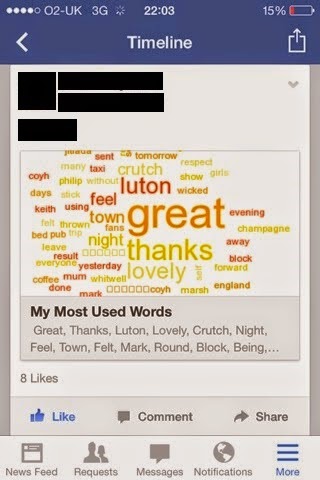
I have noticed recently that there is an app on Facebook that gathers all your most used words on your Facebook status's and presents them to you in the form of a list of words as seen below. You then also have the option to share these, this is presented in a colour coded graphic form that shows how often you use each word, the bigger it is seen the more you have used it.
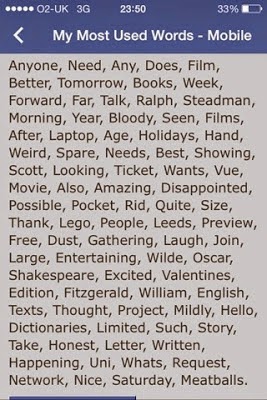
This is the order of my most used words, I quite like the idea of using these to create a short story or poem that reflects on word usage on social networks.

Further more I have collected a screenshot of my friends on Facebook who have also used this app and shared their list of words. With each collection of words I aim to create small individual stories and/or poems which I will then present them to each person. I am looking forward to the process of these, also in doing this it will help me develop my skills in creating something new from reusing words found or collected.

30/03/2014
Book Two | I didn't write a word | Found Words | Book so far

The process of this book so far is collected together in this brown paper sketchbook, so to keep it together and also to keep it in the order of how I found them. I'm not sure of the exact order I will have them, but I quite like the idea of them being in an order that represents this journey of how they were found.
So far I have 13 pieces of which 5 of them are shopping lists, 3 are work notes and 2 are small notes left for others. The collection will continue, but I should start considering how these may look in a book and the layout of this with what I have so far. The next step would be to start planning these out.
29/03/2014
Today I found a Frog | The Sad Frog Project
Found this little guy by the turnstiles at Leeds College of Art, upon its back was written "Found a frog? Facebook.com/sadfrogproject" and on the bottom his name, "Frank."

About this project (as stated on their Facebook page)
Here is a quirky little project about a Sad Frog, the
purpose is to spread some amusement and also to test the capability of social
media.
A few years ago in a charity shop in Leeds, a little Sad Frog ornament was homeless. I fell for it's pathetic and miserable little face and had to give it a home. Since then, I've been thinking and dreaming about this project.
The Sad Frog project has now begun and I have created 100 unique Sad Frogs (from a mould of the original frog). Each Sad Frog has it's name written on the bottom of it, and the link to this page on it's back.
Me and my distributing team have left 100 Sad Frogs in public places (mostly in the Yorkshire area).
The idea is that anybody who finds a frog should photograph themselves with it, post the photo to this wall with the name of the frog (which is written underneath it) and mention where you've found it. Then, the finder moves the Sad Frog to a new location for somebody else to find. Ensure that the place is safe (so that the frog won't fall and smash) and I would prefer frogs not to be left in shops.
Lets see how far each frog can travel and how many people will play the game and photograph themselves with each Frog and post it here.
__________________________________________________________
Of course I had to join in, here is a photo of me with Frank...

I know little about the artist who created this project, but what I do know is that their aim is to use this little sad frog as a way of bringing joy to people who find them, encourage people to participate in the process of the work by taking a photograph of themselves with the found frog and furthermore document the effects through social media, in this case Facebook to be exact.
By using Facebook, they are able to create a project page to state their aim, post regular and instant updates to people following the project, allow people to post up their own photographs with the frogs and keep all the documentation of the progress in one place. Not only this, Facebook is a worldwide form of social media which helps, especially as these frogs will be travelling.
This is a bit like an extension of an idea I had to document my Overheard Conversation pieces using social networks, mainly twitter as it uses short sentences, usually quote like in the way they are presented. These can then be instantly collected, reposted and spread to a wider audience. I need to research more into this and also expand by either creating a page or hashtag system for people to be able to send them.
Oh and did I mention 2 minutes later I found a unicorn in the elevator...

28/03/2014
Music | VIALKA | Wharf Chambers, Leeds
This evening I saw this experimental music, performing, dramatic duo Vialka at Wharf Chambers, not what I was expecting from my evening when I was asked if I want to go to this gig. It was so much better than expected, from what I thought would be another indie band strumming the same cords, singing about a girl. But no, my stereotypical expectation of live music was crushed and reformed as we entered the room to see and hear a single guitarist questioning the limits of music and the instrument.
Unfortunately I don't know the name of the two groups that performed before, which is a shame as they were just as wonderful as the headlining act and I would have liked to keep up with what they are doing. This will require some further digging, but anyone reading this, who saw this performance at Wharf Chambers and knows the names of the other two acts, it would be amazing if you could message me them please.

So as we sink and delve into the music, an experience as you listen to the sounds creating a story within the exposed brick walls of Wharf Chambers. I am speechless among an audience whose attention was intensely fixed on the performance as the story unfolds. The combination of sound created both with instruments and a series of household items, story based lyrics, a dressed set with a table and various props, along with lighting that was controlled and used within the performance. This wasn't just about sound, this was about a layer of things that made a performance, which is turn was one of pure experience. You had to be there to fully understand.
Unfortunately I don't know the name of the two groups that performed before, which is a shame as they were just as wonderful as the headlining act and I would have liked to keep up with what they are doing. This will require some further digging, but anyone reading this, who saw this performance at Wharf Chambers and knows the names of the other two acts, it would be amazing if you could message me them please.
So as we sink and delve into the music, an experience as you listen to the sounds creating a story within the exposed brick walls of Wharf Chambers. I am speechless among an audience whose attention was intensely fixed on the performance as the story unfolds. The combination of sound created both with instruments and a series of household items, story based lyrics, a dressed set with a table and various props, along with lighting that was controlled and used within the performance. This wasn't just about sound, this was about a layer of things that made a performance, which is turn was one of pure experience. You had to be there to fully understand.
26/03/2014
Thinking About My Practice | Poster Brief | Feedback
I just received my feedback from my poster and presentation performance and it got me thinking about my next steps from here. I took a big risk, or what felt like a big risk to me in that I had an idea and explored and presented in full without withdrawing or cutting out parts, which a knock in confidence has done in the past. What I have learnt from this experience and especially making it a performance is that it worked and I should be more confident in my work rather than worrying about it.
Making the poster was very valuable in helping me to further understand my practice, collect and contain my thoughts and ideas, as well as making a visual representation of my work that is helping me in my next steps of my practice.
The presentation has also been very valuable, my original notes ended up taking the form of a spoken word performance. Something I fear is public speaking because I stutter and mix my words, but there was something about the words for my presentation that had this rhythm and flow that just became what it did. This is something I want to explore and experiment with much further and will involve being out of my comfort zone completely, which at this point is what I need to take this all further.
Another point in my feedback which was helpful was the consideration of how the internet and social networking has and can inform my work, a possible subject to explore deeper. The below link was suggested to me as a starter for this, exploring the consideration of social media as a subject or material practice in a contemporary visual arts practice.
http://www.artnet.com/magazineus/reviews/davis/art-and-social-media8-4-10.asp
25/03/2014
Book Two | I didn't write a word | Found Words | Process of recording four
More found pieces...


I started to consider picking up any piece with writing, not just handwritten. Especially as they can tell and story and be a collection of writing I wouldn't have considered or seen before.
24/03/2014
Book Two | I didn't write a word | Found Words | Process of recording three
Some more found pieces...


The above looks like a work notice of suspension, torn to pieces. I like the idea of adding a story to these about who they belong to and why they ended up in the street.

21/03/2014
Published Writing | Film // Art | Kiss Kiss Kill Kill (For Leeds Student News)
My review of the Kiss Kiss Kill Kill exhibition, written for Leeds Student News, printed in the 21/03/2014 issue of LSi. The original can be found here.

Currently being exhibited in the Leeds College of Art Blenheim Walk Gallery, Kiss Kiss Kill Kill is a wonderful collection of graphic art posters representing an era of European Spy genre cinema that spans from the 50s to the 70s.
People instantly think of the James Bond films when Spy Films are mentioned; and that is something that is absent from this exhibition. I see this as a good thing, he is already well represented in this era of films; and Kiss Kiss Kill Kill has opened my eyes beyond this particular mind set and showed me just how big the Euro spy film era really was. Beyond the suited and booted gadget welding Bond with his arms around a woman, who represented what people wanted to be a secret agent or a Bond girl. This isn’t all that different from the other films, just take away the Bond name and you have what is the foundations of a Spy film. Bond is a franchise, a name we need to look a little beyond that to see the full appeal of this genre.
People instantly think of the James Bond films when Spy Films are mentioned; and that is something that is absent from this exhibition. I see this as a good thing, he is already well represented in this era of films; and Kiss Kiss Kill Kill has opened my eyes beyond this particular mind set and showed me just how big the Euro spy film era really was. Beyond the suited and booted gadget welding Bond with his arms around a woman, who represented what people wanted to be a secret agent or a Bond girl. This isn’t all that different from the other films, just take away the Bond name and you have what is the foundations of a Spy film. Bond is a franchise, a name we need to look a little beyond that to see the full appeal of this genre.
In 1968 Italy made 73 Spy films, which puts into context just how popular a craze these types of films really were. With such a quantity of films being made so quickly, the quality of them is something to question. But in this exhibition we don’t see the films themselves, we see the art to poster process that played a part in advertising the films; and what excited an audience into seeing them. The power of colour, balance of image and text in a graphic image form added a flare that seems to be lost within a lot of film posters now.
Here we see images that depict the role of the spy, both as a profession and a reflection of them as propaganda; as something people aspired to be. They are super beings, independent and smart. Nothing truly goes wrong in the end. A surprising addition was seeing some female representation, and not just that of the Bond girl type, women in strong empowering roles placed in the front centre of the posters. It shows a lot about the era, and a reflection on the times of the Cold War.
I had the opportunity to speak to the curator, Richard Rhys Davies, about his collection and his love of cinema. It was great to speak to someone who so passionate about his work, and this is well reflected in his exhibit.
I urge you to go see this exhibition and gaze upon the beauty of the brush like strokes and rich texture in these original posters; which have been so lovingly collected, framed and represented in the gallery space.
19/03/2014
HOARD | Towards An Archaeology of The Artist Mind | Group Meet (March)
It's that time again for the Hoard artist meet up, this month we welcome a group of new artists to the group as Hoard starts to fill up more and more space with collections, curiosities and art work. Also on the plan of action this evening, three artists critiques and a chance to discuss new work.
Group critiques
The audio for each critique will be available on the HOARD SoundCloud soon.
Ryan Thompson
Artist statement (as stated on HOARD website)
Contemporary Artist Ryan Thompson is based in Leeds, but is working throughout the country. His work transverses several mediums including film and performance, more recently leaning towards live and participatory art forms. The focus of his practice is based around fairytale culture – an umbrella term including local and global folklore, legends, mythical creatures and story telling. Appropriating these into his artistic universe helps to develop and communicate understandings of their use in forms of escapism and how their narratives and illusions work and affect us.

Jade Montserrat
Artist statement (as stated on HOARD website)
Accumulation & The Archive.
These words crop up throughout research I am undertaking as one of the resident artists at Crescent Arts, Scarborough.
I process imagery, creating an archive. This process involves printmaking, embedding images in hand-made paper, making books, performance, writing and creating sculptural objects and installations.
My participation in Hoard will allow the work to develop by transferring solitary and intimate actions performed in the studio into a space intended for exchange.
Anna-Karin Lilleengen
Artist statement (as stated on HOARD website)
Drawing on ideas from Walter Benjamin on the aura of the art object and how the era of mechanical reproduction has altered the nature of the work of art, Lilleengen creates unique pieces that express the effects of time on the physical via a camera and technique that are in themselves considered almost as transient: antique, deteriorating and, speaking of handcrafting as a process, something now almost obsolete.
Exploring the boundary between subjective and objective, she creates images that embody her inner experience of the tension, on the one hand, between the transience of the physical and, on the other hand, the perceived permanence of internal experience and aspects of the sub- and unconscious.
The forest features heavily as a setting, being a place where the safe, known personal can merge into more expansive and instinctual experiences of being. Alluding to symbols from the unconscious, such as fairytale or the magical, routes are created into a more ambiguous but perhaps more enduring sense of reality. Here transience and impermanence join with wider elemental forces that are self-renewing to form a source of solace in what is an increasingly digitised, commoditised world.
The forests of Värmland are a place where year on year Anna Lilleengen has spent time, and as such is a natural setting for her work: here the forests are reclaiming their elemental status as people move out and the wild (wolves, bears, boar) move back in. Aspects of pictorialism can be seen in her work that draws inspiration from the wet plate collodion techniques of Sally Mann. The sense of heritage and honouring history is a major strand in the work: physical heritage (the place, the body, the object) and also the spiritual legacy of family/ancestors/culture that one could say is often intuited, rather than reasoned or ‘known’.
Lilleengen creates work that requires you to look closer, reflect and navigate your own way through the darkness of the forest.


Group critiques
The audio for each critique will be available on the HOARD SoundCloud soon.
Ryan Thompson
Artist statement (as stated on HOARD website)
Contemporary Artist Ryan Thompson is based in Leeds, but is working throughout the country. His work transverses several mediums including film and performance, more recently leaning towards live and participatory art forms. The focus of his practice is based around fairytale culture – an umbrella term including local and global folklore, legends, mythical creatures and story telling. Appropriating these into his artistic universe helps to develop and communicate understandings of their use in forms of escapism and how their narratives and illusions work and affect us.

Jade Montserrat
Artist statement (as stated on HOARD website)
Accumulation & The Archive.
These words crop up throughout research I am undertaking as one of the resident artists at Crescent Arts, Scarborough.
I process imagery, creating an archive. This process involves printmaking, embedding images in hand-made paper, making books, performance, writing and creating sculptural objects and installations.
My participation in Hoard will allow the work to develop by transferring solitary and intimate actions performed in the studio into a space intended for exchange.

Anna-Karin Lilleengen
Artist statement (as stated on HOARD website)
Drawing on ideas from Walter Benjamin on the aura of the art object and how the era of mechanical reproduction has altered the nature of the work of art, Lilleengen creates unique pieces that express the effects of time on the physical via a camera and technique that are in themselves considered almost as transient: antique, deteriorating and, speaking of handcrafting as a process, something now almost obsolete.
Exploring the boundary between subjective and objective, she creates images that embody her inner experience of the tension, on the one hand, between the transience of the physical and, on the other hand, the perceived permanence of internal experience and aspects of the sub- and unconscious.
The forest features heavily as a setting, being a place where the safe, known personal can merge into more expansive and instinctual experiences of being. Alluding to symbols from the unconscious, such as fairytale or the magical, routes are created into a more ambiguous but perhaps more enduring sense of reality. Here transience and impermanence join with wider elemental forces that are self-renewing to form a source of solace in what is an increasingly digitised, commoditised world.
The forests of Värmland are a place where year on year Anna Lilleengen has spent time, and as such is a natural setting for her work: here the forests are reclaiming their elemental status as people move out and the wild (wolves, bears, boar) move back in. Aspects of pictorialism can be seen in her work that draws inspiration from the wet plate collodion techniques of Sally Mann. The sense of heritage and honouring history is a major strand in the work: physical heritage (the place, the body, the object) and also the spiritual legacy of family/ancestors/culture that one could say is often intuited, rather than reasoned or ‘known’.
Lilleengen creates work that requires you to look closer, reflect and navigate your own way through the darkness of the forest.


Book Two | I didn't write a word | Found Words | Process of recording two
Some more found notes and writing, I have started to notice a trend in lost university notes and shopping lists.


The ones I find the most interesting are the written notes left for others and also the fact these were lost which also makes me wonder if it ever made it to the people it was meant for.


The ones I find the most interesting are the written notes left for others and also the fact these were lost which also makes me wonder if it ever made it to the people it was meant for.
18/03/2014
Published Writing | Art | Gonzo Illustrator Ralph Steadman - Artist Talk (For the Leeds College of Art Website)
My review of the Artist Talk with Ralph Steadman, written for the Leeds College of Art Website. Also featured in the April 2014 issue of NEST magazine. The original can be found here.

BA (Hons) Fine Art student Paisley Boyd reviews the recent artist talk over Skype by gonzo illustrator Ralph Steadman.
Known for his distinctive style, world changing voice and collaboration with Hunter S. Thompson, it was a real honour to hear Ralph Steadman talk to a room full of inspiring young artists eager to hear everything he has to say. A man whose list of works stretch far into the distance, giving his own style, perspective and angle even to well known and much loved classic literature; using his own tone of voice to transform these pieces as his own.
Live artists talks are always a great chance for students and staff at the College to not only listen to, but to interact, get advice and in turn be fully inspired in their own work. As the Skype call rung out across the studio theatre, you could see people shuffling with excitement to then be met with the cheerful face of Captain Hat wearing Ralph Steadman and so began an insight into his studio, way of working and a body of work that stretched across his whole life career.
The talk kicked off to a cracking start as Steadman sneaked off camera to reappear with a mirror stating “something experimental here, I want to see if you can see yourselves,” as he positioned the mirror in front of the camera. What in aid of, you ask? What I originally thought was just a stunt to make us laugh took a turn I didn’t expect as he continued with “That’s what visual things are all about, the accidental, if it’s not an accident, it’s not fun. It’s not about being vicious or unkind or mean or generally unpleasant, it’s about being naughty.”
He then began show work around him and when asked “What did you make it in response to?”
He shouted, “For no good reason!”
We follow him through the studio tour room after room, in a labyrinth of ink, paper and a trumpet of which Ralph gives us a show, unfortunately just as the screen freezes; a wave of sighs and oh no’s showing just how much the audiences was enjoying this.
It was very exciting to see his work as a student. As his daughter stated “even Ralph had to learn somewhere,” it is easy to forget that every creative person starts off somewhere and we usually see them for the voice they have developed over time and through life experiences; which can be a little bit scary for students to see as they try to figure out their own path. To see someone such as Ralph Steadman from the start helped to piece together the story and journey of his creative process. He not only showed us his earlier work, he told us how they came about, what formed this and who taught him. A point at which a lot of us are at, it is refreshing to hear this first hand from artists you admire. Learning from the tutor during life drawing, he describes it as “making a mess and not getting it right for the tutor to come over and point out mistakes” This would happen 24 times in each class, creating 24 individual lessons. It’s funny to hear how he was taught this way; mainly for his ideology that there are “no such thing as mistakes.” Ralph entertained us with short anecdotes about some of the characters that used to life model, which a lot of people who go to life drawing classes can relate to; making you realise you're not alone and what a laugh it is.
“I really wanted to learn to draw, most importantly.”
Let's look at the drawings “to hell with me,” proclaims Steadman as he stands behind a stack of work, and we are given a special look into some selected works among the mountain of papers. Scrolling through pieces such as a gardener watering his awards, a man going to get a book from a library, but having his forehead stamped instead. A weatherman being pelted because he is giving us a bad performance, a street band with a grand piano, a man in a canoe with a horn and a vicar going to get a new suit.
“I was trying to be rebellious in my work, which gave it a sort of edge. I wanted edge in it, if you don’t get that it’s uninteresting and such. If it doesn’t excite me what the hell is it going to do for someone else? It’s about conveying your inner self, you’re externalizing it on paper or whatever you use, canvas, acetate, anything!”
“It had to sort of either make people angry, amused, it had to do something really positive otherwise it was just a drawing filling a space The finished pieces research stories and rough sketches all help to clarify Ralph’s way of working and thought processes. “It must be first hand, you don’t go and report on the story you become the story. That’s what gonzo journalism was.”
As the talk came to an end, students were able to ask questions, which sparked all manners of interesting, wild answers. From “Will you be my Valentine Ralph?” A question that ended in an exchange of drawings and a “Yes”. To mistakes and erasing, with a shouted response of “DON'T RUB OUT! There is no such thing as a mistake, it is an opportunity to do something else.” The question asking the difference between good illustration and truly great illustration sparked an inspirational response about honesty; illustration is a diagram nothing more, we do drawings and the meaning of the art to the artist. “We are too full of rules and regulations now; it’s the death of fun,” leading on to a fantastic story about the past with Hunter S. Thompson involving expensive yachts and spray paint. And ending on “What advice would you give to a student starting out?” the instant response being “give it up.” Or “dedicate your life to making mistakes that matter.”
Illustration student Sophie Wright was involved in asking one of these questions, and I had the opportunity to ask her about this experience.
“As a fan of Steadman’s through “Fear and Loathing”, getting to speak to him and also having the opportunity to look through his other work was an amazing experience.”
It is safe to say Ralph Steadman is an illustrator who has changed the world through his life time of work, that stands loud and proud. He portrayed his unique tone across everything he applies ink to and, on top of that, gave a talk that has influenced and motivated everyone in the room in their own practice. Everyone left with a smile on their faces, heads full of inspirational words, and a feeling that they could take on the world.
Subscribe to:
Posts (Atom)