Final Piece

Final Piece

About the Blog

This blog is a representation of my working progress as an Artist and Writing. Everything here is an example of my work and a journey through my working. It acts as a documentation of various projects, ideas and rough experiments, starting from my time at University and beyond.

25/02/2014

Thinking About My Practice | Poster Brief | InDesign Workshop / Content

Not knowing much about InDesign and having not used it before I was a little worried about my poster brief, which states that it has to be created on this software. However after a days session on InDesign I found it was a lot easier than it looks, also it will benefit my work greatly, especially in organizing text for digital print, even more so as a text print or book form.

My first steps in creating the twitter feed template involved taking a screenshot of my own twitter feed in order to use this as a base. This made the whole process even easier as my next steps were to simply create boxes mimicking that of what was present underneath.

By doing so it started to look like this...


By doing this also I was able to layout the text in a similar way, making it look realistic and also allowing me to add my own touches to it that I wouldn't have been able to do so on my own twitter page. 

From left down to right up of content position:

Top Bar - Stays the same 

Left Box 1 - The same, with 'Tweets' in bold to represent what page it would currently be on. 

Left Box 2 - Still labelled 'Photos and Videos,' however I have added in images of my last few pieces of work and my own images that represent my current practice. 

Left Box 3 - Still labelled as 'Who to follow,' of which I have changed the images and text to artists and books/magazines I have recently been recommended to research. 

Left Box 4 - Still labelled as 'Trends,' however I have changed the original hashtag trends to a list of words associated with my practice all put in hashtag form e.g. #Dada, #Font #Typewriter.... 

Left Box 5 - The copyright text has been replaced with links to my blog, website and also my email, twitter and instagram accounts. 

Right Box 6 - Still labelled as 'Tweets,' but instead of adding my current list of them, I have created a series of tweets from a series of artists, writers and myself that illustrate theory, content and ideas behind my work.

Right Box 7 - Still set out as profile page, but rather than a few 'about' words I have added my artist statement to this which is a short paragraph that underlines the key components of what I do. 

The poster is starting to come along at this point as well as my presentation which will go alongside this. 

Exhibition Consideration | Overheard Conversation Collection | Paper

I have started to take consideration of my presentation of these sentences further, thinking about paper to use. Before I used a cream A5 letter paper, the size worked well with the size of the text from the typewriter so this is to remain the same. However I am limited to the cream paper now as the stock has been discontinued, however the cream may not have been the right paper for it in the first place.


I tested out using a blue graph paper and a thinner white paper all of the same size. The idea was the have three versions of each sentence, in order to create a series of paper that reflects on the idea of slowly loosing sentences. But this all became too complicated and if they were to be handed out to different people the connection wouldn't work.

So between the three, the blue graph was too busy, messy and took the attention away from the sentences. The cream I am limited on, meaning that only a small collection would be made, but also it was quite thick and maybe too nice of a paper for this throwaway comment idea. The last is the thin white paper, which does seem quite throwaway and temporary. Also I am able to get my hands on a large quantity of this type, which takes away that limit. I need to make enough to match the amount of handouts and there needs to be enough of these for the amount of visitors that are likely to take one. We estimated around 150 handouts would be enough, taking into consideration those who wouldn't be taking one as well.

24/02/2014

Exhibition Invite | Open Closet at Lamberts Yard | Leeds College of Art Level 5 End of Year Show

In a couple of months our course nears the end of the Second Year. Of which are all set and ready for our exhibition which is opening on Thursday 6th March and running over that weekend at Lamberts Yard. You are all invited to the Opening Night of this Leeds College of Art Fine Art exhibition to see a range of contemporary works from just over 40 artists. 

Link to Facebook event


23/02/2014

Published Writing | Film | The Lego Movie – This film is for you, whatever your age (For Leeds Student News)

My review of the Lego Movie written for Leeds Student News, printed in the 21/02/2014 issue of LSi. The original can be found here.


Image: Warner Bros.
No words can fully describe how excited I was for this film. Not only is it a Lego movie, it was created by the same guys who made Cloudy with a Chance of Meatballs. By taking an ordinary minifigure called Emmet and making him extraordinary, the Lego Movie formed something you don’t quite expect from a childrens movie. This film very much sits with the style of Wreck it Ralph in that it appeals to a young audience in its form and colour, and it appeals to older audiences through thoughtful ideas, dialogue and memories of the past.
There’s much more to this movie than just lots of colourful bricks. It centres around solid morals and a story questioning a whole range of issues. On the surface it’s extra fun and entertaining, as the master builders attempt to save the day from President Business destroying the Lego city. Where else could you find Batman, Superman, Abraham Lincoln and Gandalf all in one movie?
You are transported to the Lego universe as you follow a huge cast of actors playing very diverse characters. I enjoyed the character of ‘Benny the 80s Something Space Guy’ and I wasn’t alone. One child insisted on quoting this character even after his parents told him off. This film managed to keep up a love of Lego for fans of all ages as well as keeping the storyline a surprise. It all boiled down to a thoughtful and interesting ending that I didn’t expect. No matter what your age, don’t be embarrassed to go and see this film; it isn’t just made for fans of the franchise, but also for those who just want a laugh.

18/02/2014

Published Writing | BAFTA Roundup | 12 Years A Slave wins Best Picture (For Leeds Student News Online)

My 2014 BAFTA overview written for Leeds Student News, as an online special. The original can be found here.

Last Sunday was time again to celebrate not only the past year in film, but also the people who made it happen and those among them we lost this year. The BAFTAs 2014 saw Gravity, 12 Years a Slave and American Hustle emerge as the big winners of the night.
I did something I don’t normally do when I view awards ceremonies, and that is watch the red carpet coverage. Honestly, you’re never missing much that the awards themselves don’t cover in the terms of dresses and general chit chat; however one thing that isn’t present inside the Royal Opera House is the deafening screams of star struck fans in their desperation to get an autograph. So much so that Oprah Winfrey said of her first time at the BAFTAs “I thought it would be very British and Subdued.. NO!” At least the weather held up, which is often the most unpredictably British part of the awards, and thankfully for the A-listers and their hairdos, it didn’t rain this year.
Film awards can be very hit and miss. It not only depends the films, the stars, but also the most important point of all, the host. National treasure Stephen Fry is always an utter delight and last year he hosted the BAFTAs with characteristic wisdom and wit. This year however saw a more nervous, more subdued Fry. His jokes kept a level of slight playfulness, but stayed safe enough not to upset anyone, including the opening line “I find myself humbled, honoured and – in the best sense of the word – paid to be here.” Fry continued the joyous jokes by asking Leonardo Dicaprio to continue a BAFTA tradition and blow a kiss to the camera in his explanation that “we drew lots until your name came out, what are the odds of that?”
Onwards with the night, and we saw a film and music montage from Tinie Tempah and Laura Mvula with clips from the past year of films which reminded me of some fantastic films overlooked in the nominations. The performance was a little odd, and the response from the crowd seemed to reflect that; news of Tinnie’s high five with Prince William erupted on twitter not long after. Fry jumped in just before the announcements to address what can be one of the most painful elements of these ceremonies, in the most British way possible, by saying that when you say thank you after receiving a cup of tea “you don’t thank the kettle, the cup, the milk, the cow, the tea picker.”
The night saw Alfonso Cuaron’s space thriller Gravity bag several awards, including Best Director and Outstanding British Film, which makes one wonder what actually constitutes a British production: is it just based on where the thing is filmed? Gravity also went on to win Best Sound, an award accepted with a cheeky “there is no sound in space, but there you go.” Universally acclaimed 12 Years a Slave was another close contender, winning both Best Picture and Best Actor for Chiwetel Ejiofor. However, the award I was most interested in was The EE Rising Star Award, partially voted for by the public. Dane DeHaan, George MacKay, Lupita Nyong’o and Léa Seydoux were all fantastic nominations, but the award was deservingly won by Will Poulter of Son of Rambow and We’re the Millers fame, who gave a very heartfelt speech. A few other inspiring acceptance speeches that should be noted include Cate Blanchett’s after picking up her award for Leading Actress in Blue Jasmine. In a gracious and touching manner, she dedicated her award to the late Philip Seymour Hoffman. Last but not least came Dame Helen Mirren who picked up this year’s Fellowship award and gave a thoughtful speech about remembering those who inspired you and, in doing so, thanking them.
Through award ceremonies we remember the films of that year, give praise to exceptional films and remember those in the industry whom the world has lost. It is a celebration of all things film and those who are a part of it as both makers and viewers, something that will hopefully go on to inspire future film makers.

17/02/2014

Thinking About My Practice | Poster Brief | Layout ideas

For my academic poster the first thing I needed to think about is the layout of my poster, the best thing to do being to take a already existing layout of which I can either add to or recreate on InDesign. The template needs to be something that reflects my practice, especially as it will be the center of my poster.

I decided either something to do with text, text placement or social networks. Below are some of the ideas I have considered...

A book layout

Using a book layout would allow me to not only layout text, but as seen below, if positioned properly I can form it using images, text, diagrams and so on making it a multi function. However it would need structuring more as a spread of two pages may become a little overpowered with content and loose what I am trying to show.


If I was to use this layout, I would create it as seen bellow as an open book in the center of the poster, allowing people to see that it is a book to draw the connection between text and where is may be found.


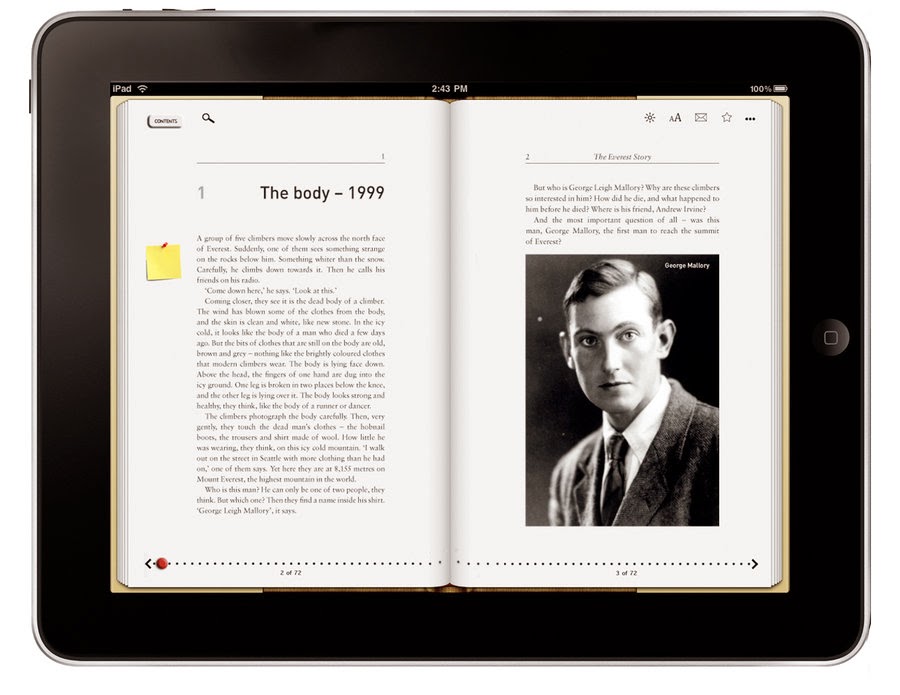
A step beyond this might be to make it a digital book as seen below, drawing in this connection of digital with what was originally a printed source.


 A script layout

Another layout that represents where text may be found, also tying in my uses of scripts in my work and also my interest and influence of film and screen. However a script layout is limited to text only and a limit to what can be presented on a page to keep it a script, so this wouldn't work so well.


Typewriter layout

Mainly because of my uses of a typewriter often in my work, however it is limited to text only and a limited amount of.


Instagram layout

The Instagram layout is taking the social network and digital route, however it has the opposite limits to the above, it has the opportunity for large amounts of images, but is very limited on text and this is a problem as my practice revolves around it.


Twitter layout 

Considering all the choices, a twitter feed would be the best, not only does it center around text and social networking, I am able to add images and an artist profile to it. On the plus side, I can add tweets from relevant artists and create a timeline of my practice.

It would be the best choice to show my practice bringing together a series of ideas and work into one poster, making it easy to read and understand.


16/02/2014

Published Writing | Film | Robocop – Robo reboot falls flat (For Leeds Student News)

My review of Robocop written for Leeds Student News, printed in the 14/02/2014 issue of LSi. The original can be found here.
Image: MGM
The mere mention of Robocop can prompt an awkward shuffle. The long drawn out sighs before some cries “why are they remaking it? Why?!” This was my reaction too, until a recent realisation: we are making reboots harder for ourselves to watch. The industry is going to keep making them anyway, so why not embrace it and see what this new take has to offer. I found the best way to do this is to go in without the mindset of comparing it to the original. Like countless others I hold Robocop close to my heart. It’s a film I saw as a child and loved. He was a badass version of Inspector Gadget.
Set in a near future Detroit, the new adaptation takes on the topical idea of robots and drones being used more in conflicts. OmniCorp are pushing for more robots to be used in law enforcement because it expands their profit margin. In an attempt to win the public’s vote, they introduce Alex Murphy, a cop injured in the line of duty to become the bridge between what it is to be human and mindless killing drone. The film sets up the opportunity to question the contrast between machine and man, corporation marketing and pushy biased media. While it touches on all of these ideas, it never really succeeds in doing so. Instead it struggles in creating any emotionally real characters, let alone Robocop himself. By trying to humanize a robot it ends up dehumanizing its other characters.
Transforming the entire plot into more of a simulation of a computer game, in what may be an attempt to appeal to its younger audience. Robocop now has become something of a generic action movie: it has gun fights, high speed chases and a shouty Samuel L. Jackson. The film really does fall flat.

13/02/2014

Exhibition Consideration | Overheard Conversation Collection | Producing a handout

An important part of my work is this exhibition handout, which has partly become my role in helping to make it working alongside Liam Mayer who has taken a lead role in the running of this exhibition. His role includes laying out the work, the logistics of getting it to and into the space, so he is the one to work with when it comes to producing a small handout containing a map and location of the work.

After discussions we decided this would work best if it was a A3 double sided handout that is then folded down to a A5. Mainly so that we can fit all the information on it without squashing it in and also to be able to hold my work without it falling out.

Another decision was to add a map, a basic line drawn floor plan that would fit on half of a page, each work labelled as a number on it. Which then on the full page of the other side, have the numbers along side the artists name and work name as a reference to find peoples work. Also the aim was to have the title on one A5 segment of the leaflet that would be the side facing up.

We will start laying out the map and where the text will go in InDesign then when we get the information come through we can start adding to it, so it is ready to print.


05/02/2014

Exhibition Consideration | Overheard Conversation Collection | How to present it

In thinking about ways of presenting the idea of the Overheard Conversations I have collected, I need to consider the aims of the piece and what I am trying to achieve. I want to use the overheard sentences, recorded from one environment, documented and preserved rather than being lost with the rest of everyday conversation. Then using them to recreate a similar situation within a different environment, keeping them throwaway, but at the same time engaging to an audience who hopefully will response and interpret the short sentences. Also showing that the same words can have a variety of meanings.

Presentation Ideas

I left the project at the point of the bowl presentation form on a plinth, as the previous A5 typed sheets in a pile on a plinth were too organised that people wouldn't pick it up and interact with them. This meant that the idea didn't work, so the bowl form was created as a way of encouraging people to take from it and read. This did work in that sense, however it was too literal and didn't work to my aims, it was awkward and I think the plinth presentation is to be avoided completely, especially with something like this. Another problem with this work is that the sentences are unedited and some of them weren't right as they were closed sentences and didn't leave much to the audience to interpret. So something new needs to be considered.


During thinking about this I had a discussion in the studio with some others that were around. We discussed this throwaway idea that maybe I could create a tear and take sheet for people to take sentences, this does create a 'i'm here to take' approach, however this encourages people to see and read the sentences before hand, meaning that they make a conscious decision to decide what to take if they choose to take. Also this may work better around the college rather than in an exhibition space.

Same idea as below, but different content.


The next idea went back to how I previously typed the words on A5 sheet, however avoiding a plinth and piling them up. It needed a different set up that would encourage people to find them rather than be in a obvious place that doesn't interest people so much, they simple just see it and walk on.

So came the idea of scattering them around the exhibition space as if they had already been seen and just dropped, I liked this idea, but maybe as an outcome rather than setting out to do so. So I thought about simply handing them out. But this brings me back to the same problem of  them being obviously there. Then I thought about what can be handed out at an exhibition and hiding them in that.

If we produced exhibition handouts containing maps, people will take them as they want to know which is which work. By hiding them in this handout, people will take them without knowing, hiding them in plain sight. Only when they open them will they see the paper, and this starts a cycle of either dropping them as they don't see them and someone else trying to retrieve it or seeing it and wondering what it is. I like this idea, after further discussions, I decided to try this idea out, which means my next steps are to plan and make an exhibition leaflet.

03/02/2014

Exhibition Consideration | Refining my idea | Overheard Conversation Collection

As the exhibition deadline approaches, it got me thinking about some new ideas I have that involves making some books, however I am worried that with just over a month before the exhibition, it would involve working really fast to complete these new ideas that are in their early forms, by doing so they won't be refined and may not work as well as they could.

My other option is to refine past work, and being that I feel the last project isn't fully finished, I think I am best starting from where I finished before. Which means I am stuck at how to present my overheard conversation pieces.

I need to consider how to present this idea, I need to think about using the overheard conversations in the way that people will interact with them, but not being too forceful and literal about the presentation, which the bowl presentation before was.

This will require further thinking and exploration, which I am taking for my exhibition piece. Making a new piece doesn't make sense, I need to take more time to think and consider my work rather than rush through the process, starting at this point.

31/01/2014

Workshop | Audio | Part 2 | Making a Sound Installation

The second day of the sound workshop got more experimental. Having explored ways of recording sounds, today I had the chance to use different ways of presenting sounds. Using various sensors that changing pitch, speed, volume and echoes. The studio theatre became a interactive soundscape consisting of four free standing speakers connected up to a laptop in the middle controlling the affect the sensors have on the sound.


Light sensor 

Does exactly as the name suggests, depending on the level of light it is exposed to it will change various aspects of the sound like volume, pitch and speed depending what you set it to. We connected it to a speaker, using it as a volume control, when the light was on it was on at full volume, as the light dims, so does the volume of the sound connected to it. In darkness it is muted. I played with the idea of blacking out the room and controlling the light source through a lamp, which could be moved and dimmed to manipulate the sound.


Pressure sensor on the floor

Unlike the light sensor which has a steady gradient level, the pressure sensor is a simple on/off switch which as it says responses to the pressure added to it. Placed on the floor we have invited people to step on it to turn the sound from the speaker on and once their foot is removed it switches straight off.

Flex sensor on my hand

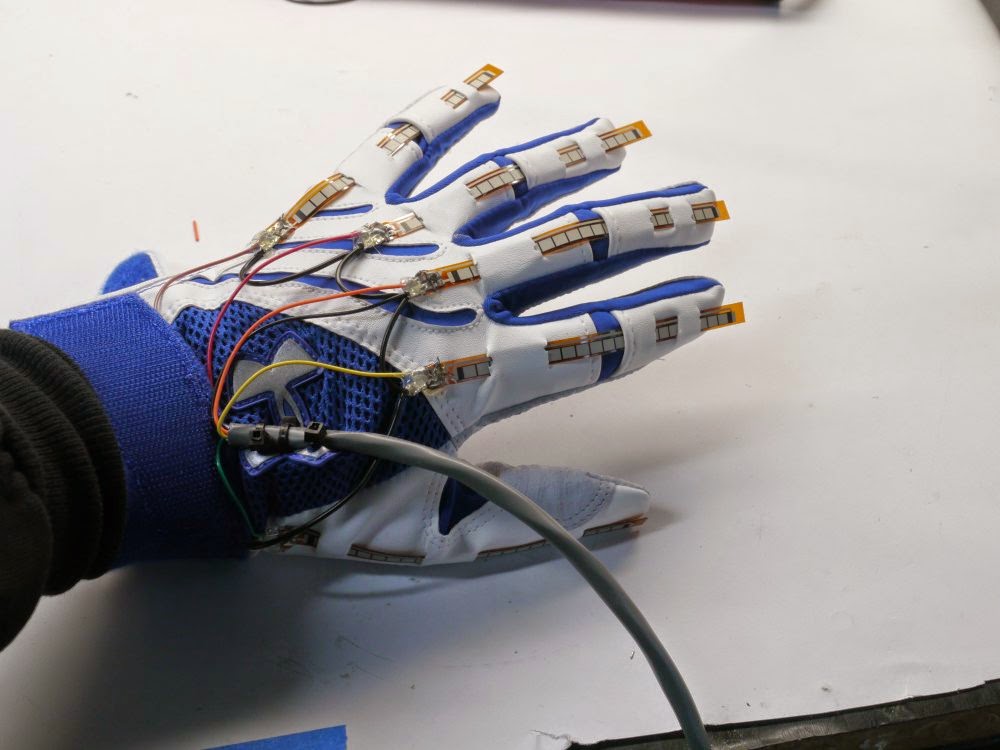
These flat sensors enable you to pick up movement as they are flat and can stick to your body, like above I attempted to pick up the moment in my hand, with the final outcome of attaching a strip on each finger to pick up each individual bend in my fingers. Unfortunately masking taping them to my finger causes it to limit movement and what the sensor picked up, however on further investigation I found it is possible to create gloves as seen below, these hold the sensors in place and tidily, also allowing full moment of the hand. I like the idea of trying this out. My idea is to play with the notion of non verbal, almost silent communication such as sign language and using these sensors to get an idea for what it would sound like to add sound to body language. This is an idea to come off the back of this workshop and I will return to it at a later date.


Laser and light sensor combination

The laser works with the light sensor to create another on/off switch this time if the laser line is walked through which breaks the connection. The laser is placed at one side and the light across from it so that the laser lands directly into the light sensor. This one is a little fiddly to get lined up and can sometimes slip slightly causing it to break the connection. But if stable works well.


Using all these techniques, sensors and sample sounds we set up an interactive walk through around the studio theatre. Below is some sample videos of the final piece created from the workshop. 


I have a lot to consider from this workshop and I am defiantly going to revisit the flex sensors, if not all of them. There is so much to explore, this day was only a tiny bit of it. These sensors can also be hooked up to video and controlling the visuals in the same way it did to the sound. 

28/01/2014

Workshop | Pinhole Photography | Part 2 | Further Exploration

The second part of the Pinhole workshop was a chance to use our basic knowledge of the technique and explore with different types of pinhole and using different containers. I decided this time I would try a harder form from the box pinholes and create a matchbox camera using film this time. Using film can lead to sharper images and only needs a short exposure time, seconds compared to the minutes in the box ones.

Steps of making a Match Box Film Pinhole Camera

Things you need:
-Black marker
-Match Box
-Empty film canister
-35mm black and white film
-Black tape
-Black foil
-Small piece of thick card
-Blue tack

1. Taking the match box and a black marker I coloured the inside of the box black in order to stop any light leaking through the box as this would either mist or completely void the image.


2. Once the inside is blacked out, I cut a small box in the center of the sleeve, it is important that it is in the middle in order to make sure the pinhole in center so that the light reaches the piece of film. I then cut out a frame in the box bottom, you can use any shape and size (limited to the size of the box), this allows you to add a frame to the image if wanted. Examples being a circle, so that the image is only present in that rounded shape on the film and the rest is black.


3. Now tape the black foil onto the little window on the sleeve and add a very small hole in the center of this. Now slide the frame back into the sleeve and feed the film through as seen below. The matte side facing the hole.


4. Feed the film into the empty reel and close the canister. Make sure this is tight and will enable you to twist it round to take the film. Tape both of these tightly together, remember which side has the film in it and which is empty, mark this if needed.


5. Fully cover the camera in the black tape, making sure no light will leak in. Mark which side is unexposed, so you know which direction to turn it. Add the thick card as a little door over the hole so you can open and close it, seal with the blue tack when you aren't using it.


6. Now the camera is ready to take out, exposing each part of the film, ranging from 25-40 seconds each time. Then covering the hole and twisting 2/3 full turns toward the exposed section of the canister.


Unfortunately when I took it back to the dark room and developed the film I found I didn't tighten the connection enough and it came loose, meaning that the film didn't turn. So I was unsuccessful this time, however for next time I know to tape the connection and tighten it more than before. Also making the frame as big as a did meant that the film got trapped in it, so next time I will try a smaller frame to avoid this.

24/01/2014

Workshop | Audio | Part 1 | Experimenting with recording sounds

Today's sound workshop covered various ways of recording sound using different microphones and sensors to pick up various different types of vibrations that create sound.


First we used used a contact microphone, these pick up the vibrations of the surface they are on and won't pick up voices and other similar sounds. These are connected up to handheld audio recorders in order to collect the sounds.


Here we used a contact microphone on the metal table and a piece of string from this with a ruler hanging in the middle of this. By hitting the ruler, it sends vibrations up through the string into the contact microphone, creating a ringing sound. The same idea as a string and can phones.


I tried the contact on a variety of surfaces, firstly the table which gave a low droning sound, which when put onto walls or the floor unless disturbed or stood on, all made that similar sound. The window however created sounds that both took the sounds of the outside and inside, through the window the outside sounds of traffic bounced off the window creating an echo effect. We tired it on the tree next, hoping we could pick up the sound of the movement of birds in the tree or the wind blowing it. This wasn't the case and we didn't pick up anything.


The last we microphone we tried was a hydrophone which records under water sounds. We placed it in a cup of water, along with a contact microphone on the outside and recorded what it sounds like to blow bubbles through a straw into water, taking the contract between inside the water and the sound from the cup. It created a lower sound of bubbles being blown into water, but made an eerier sound.

Some of the sounds recorded today can be found below from my sound cloud account.

23/01/2014

HOARD | Towards An Archaeology of The Artist Mind | Exhibition (January)

The second HOARD exhibition I have attended that runs alongside the Vantage Art Prize. Having been to see HOARD just about a month beforehand I was surprised to how much this exhibition has actually changed. It is a constant changing project, however the rate it is changing is extremely fast, each visit there is something completely new or expanded in the collection of items by these artists.


Some pieces use audience interaction to expand and grow as a collection.
Above is the work of Hazel Smoczynska and Rosie Parsons who are Frauhaus.

Artist statement

Frauhaus is a lingering fear of the ghosts of the cold war and the horrors of the 21st century. Haunted walking, lost answer phone messages, future shock, and unfamiliar sounds in in familiar places. We listen and give voice to the information, planning and anxiety of the recent past, and make space for it in the present.

Frauhaus’ starting point for this project was the BBC transcript to be used in wake of nuclear attack. Collected recordings of this ‘last broadcast’ form part of the installation, alongside a place to retreat.

-----

The first Hoard exhibition I was at they were inviting people to record their voice reading and a transcript. This time round the audio playing is people from the last exhibition reading the transcript. They use audience interact to inform their next steps for the project, first connected with the BBC transcript now branching out from this one focus point.


Above is the work of Jade Montserrat, the last time I saw her work it was a mixture of furniture and items that were wrapped in tape, changing its form and structure. Now these items and others have been transformed into an archive housed in a series of hand made boxes, each labeled and documented in a catalogue, placed on the table by the boxes.

It's not just impressive to look at from a distance, the way of stacking has made a wall that forms a sort of stage in the middle. By stacking and documenting each box with a chalked reference number, it makes you wonder more about what is in the boxes. Which encourages you to return to the catalogue and look it up. As the work spreads out so does the ideas and subjects Jade tackles. These series of boxes have come to an end for now, but the process of exploration continues.


As the exhibition comes to an end, the exploration and work of HOARD will still be changing and continuing. I look forward to seeing how this may differ to the next exhibition.

Workshop | Pinhole Photography | Part 1 | Building a box pinhole

Today we had the opportunity to do a Pinhole Photography workshop, I have always been interested in giving it a try, especially as I like the idea of having less control over this type of photography, you are unable to see what it exactly is you're taking an image of. It takes time and knowledge to explore this type of photography by which point you can make educated estimates on lighting, timing, direction and also the limits of the practice.


By using a pre-laser cut box template, we each created our pinhole boxes that would fit an A6 piece of light sensitive paper at the back of the box, of which on the opposite side of this container is a small hole for the light to enter. 


Each location required a different time to leave the paper exposed. Out on the square was around 2 minutes, the courtyard of Vernon street was about 15 minutes due to the darker, move covered area. These were taken all based on guesses and at times a light meter reading. Each time the paper is exposed it requires returning to the dark room and developing the image, firstly to avoid the paper seeing light after the image is taken and secondly to see the results of the image, which will inform your next moves in considering light and timing. 


After we exposed the paper, we developed them creating an image negative as seen on the left of the image below. Once fixed and dried in the dark room, this is then place on top of another piece of paper and exposed to light from the enlarger. This once developed again produces a positive to the negative. My favourite image created from the day is the one seen below, I love how the positive and negative match up to create this left and right contrast. 


Experimenting with photography is something I want to take further as well as super8 film, all an interest of mine and the experimenting involved in these processes. 

18/01/2014

Research | The uses of found words | On the internet | YouTube

Looking further into how existing words and conversations can be used, especially on YouTube, considering ideas of how to further my own work.

I found other ways that YouTube comments have be reused, unlike Adam Buxton's stand up comedy style, these readings take a different approach. By using the comments as a script they have recreated these conversations into dramas, creating dramatic readings in a film like scenario. 


The next set of videos I looked at is a campaign from a YouTube musician, to send him tweets of which he would on the spot create a song using them. Unedited words, parts working, parts clashing, but creating something that wouldn't have been written without this element of chance. 


A lot of these channels use the instant nature of the internet to gather information, and also the memorable, entertainment value to get audiences to watch their videos, instead of others in a mass of YouTube videos. 

16/01/2014

Research | The uses of found words | On the internet | Adam Buxton

I'm taking a further a look into the uses of existing/found words and how others may have used them to make new creations, performances and so on.  On of these resources for streams of text is the internet. In looking at the internet and especially YouTube, its always worth starting with the king of YouTube Adam Buxton.

I first came across Buxton's work when I attended a Creative Networks event last year where he was the guest speaker for that month. Buxton's career is made up of silly comedy like videos that have been taken to the platform of YouTube. He also uses YouTube and existing videos and content to produce more work which can be found in his television show 'Bug'.

His show Bug takes videos, mainly music videos from YouTube, showcasing the weird and wonderful that are out there. He also does a section where he talks through the comments made by people toward the video in question. He performs them as he would imagine to what the person would act, look and sound like. All under a jokey tone, analysing the conversations that arise and turning it into a stand up style of comedy.


The idea of voicing over words, and turning them into a performance is one that interests me. Rather than write from a blank sheet, it takes the approach of taking a page of existing text and molding it into something new. By not editing the comments, Buxton uses the misspelling, bad grammar and slang as a commentary on how the internet is used and the type of communication that arises. Also to make it funny.

Also I have noticed the successful YouTube videos that get the audiences, are quite short, straight to the point, usually funny and/or memorable. YouTube is instant entertainment with an demanding audience, if art is to become a part of it, it would have to mould to that also.


13/01/2014

New Project | No Sketchbook

As I am given a new brief and the new project begins, I have chosen to continue with the same idea and thought processes before. However I have decided to do one thing differently and that is to ditch working directly and solely into a sketch book. Through the last project I have become so bogged down in filling the pages of each book to find that one, I don't explore outside of this very well and two it becomes stuck in a book and that is it.


So I have decided to remove the sketch book completely and document the whole project process on this blog, this way I can write and update any ideas any where I am, keep others updated on what I am doing, create an online presence of my work and also document further projects and work I have been apart of.

What use is a sketch book if I was just writing in it then not reviewing over it again, now I am able to search, organise and re find my ideas when I need them.

This blog will be regularly updated, personal, both formal and informal, it will be a stream of ideas that will be dated and stored. And if it is read and liked by others, that is an added bonus.